

Building With Your Brain’s Strengths: A Framework for Neurodivergent Leaders

There’s a version of you that exists mostly in your head. This version wakes up early without an alarm, answers every email the day it arrives, sits still in back-to-back meetings without needing to move or doodle or leave, and never once forgets a deadline because they were hyperfocused on something more interesting three days earlier. This version runs a calm, orderly company. This version does not exist, but you’ve spent years trying to become them anyway.
If you’re a neurodivergent founder or leader, ADHD, autistic, AuDHD, or some combination you’re still figuring out, you already know this exhausting default. Force yourself into a leadership mold built for a neurotypical brain, white-knuckle your way through the parts that don’t fit, and quietly conclude that your struggles are a discipline problem. It’s a strategy that works right up until it doesn’t, and for most people reading this, it stopped working a while ago.
This piece is the alternative. Not a set of hacks to make you act more “normal,” but a different starting premise entirely: your brain isn’t the obstacle to your leadership. It’s the terrain. And like any terrain, it has a route through it — you just need to stop trying to walk a path that was mapped for someone else’s mountain.
Why Most Leadership Advice Fails Neurodivergent Leaders
Open almost any leadership book, podcast, or LinkedIn carousel and you’ll find the same underlying assumptions: consistent daily habits are achievable through willpower, focus is a resource you can summon on command, and emotional regulation in high-stakes moments is mostly a matter of practice. None of that is malicious, it’s just written by and for brains that are wired for that kind of steadiness.
For a neurodivergent brain, those assumptions aren’t a stretch goal. They’re a different operating system. When the advice doesn’t work, the usual conclusion isn’t “this advice wasn’t built for me”, it’s “something is wrong with me.” That’s the “failure” mode: not that the advice is actively harmful, but that it sets a baseline you were never going to hit, and then leaves you to explain the gap to yourself in the worst possible terms.
The fix isn’t more willpower or a better morning routine. It’s leadership guidance that starts from how your brain actually works, its real rhythms, its real triggers, its real strengths, instead of the idealized version every framework assumes by default.
The Four Friction Points Almost Every Neurodivergent Founder Hits
Across years of working with founders and leaders navigating this exact terrain, the same four pressure points show up again and again. Each one deserves its own deep dive, but here’s the short version of why each one matters.
Time Blindness Isn’t a Character Flaw
Chronic lateness, blown deadlines, and a warped internal sense of “how long that will take” get read as sloppiness or lack of respect for other people’s time. In reality, time blindness is a well-documented feature of ADHD brains, a difference in how the brain perceives and tracks time, not a moral failing. Once you understand it as a wiring issue instead of a willpower issue, you can build real external systems around it instead of just trying harder. Read the full breakdown in Why “Time Blindness” Isn’t a Character Flaw: A Guide for ADHD Founders. (future blog post)
Masking Has a Cost, and You’re the One Paying It
Editing yourself constantly- what you say, how you say it, how animated or subdued you let yourself be in a room, is exhausting in a way that rarely shows up on paper. Over time it doesn’t just drain your energy, it starts to erode your sense of which instincts are actually yours. High-performing neurodivergent leaders often don’t notice how much they’re masking until the cost catches up with them, usually as burnout, resentment, or a growing sense of disconnection from their own leadership. The full picture is in The Cost of Masking: What High-Performing Neurodivergent Leaders Give Up to “Fit In”. (future blog post)
The Boom-Bust Cycle Isn’t Inconsistency, It’s a Pattern
Weeks of hyperfocused, high-output momentum followed by a crash into fog, avoidance, or outright shutdown — then guilt about the crash, which fuels the next overcorrection. It feels like inconsistency, but it’s actually a predictable cycle with identifiable triggers, and predictable cycles can be interrupted. This is one of the most common patterns among neurodivergent founders and one of the most fixable once it’s named. Go deeper in Boom-Bust Cycles: Why Neurodivergent Founders Swing Between Hyperfocus and Burnout — and How to Break the Pattern. (future blog post)
A Late Diagnosis Doesn’t Come With an Instruction Manual
Getting diagnosed as an adult, especially after you’ve already built and are actively running a company, creates a strange kind of disorientation. Suddenly years of your own history make a new kind of sense, but there’s no clear next step for what to actually do about it while still running a business. That gap between “this explains a lot” and “now what” is exactly where a lot of leaders get stuck. It’s covered in full in Diagnosed as an Adult, Already Running a Company: What Actually Comes Next. (future blog post)
These four aren’t separate problems. They’re different faces of the same root issue: trying to lead using a blueprint that was never drawn for your brain.
The Framework: Building With Your Brain, Not Against It
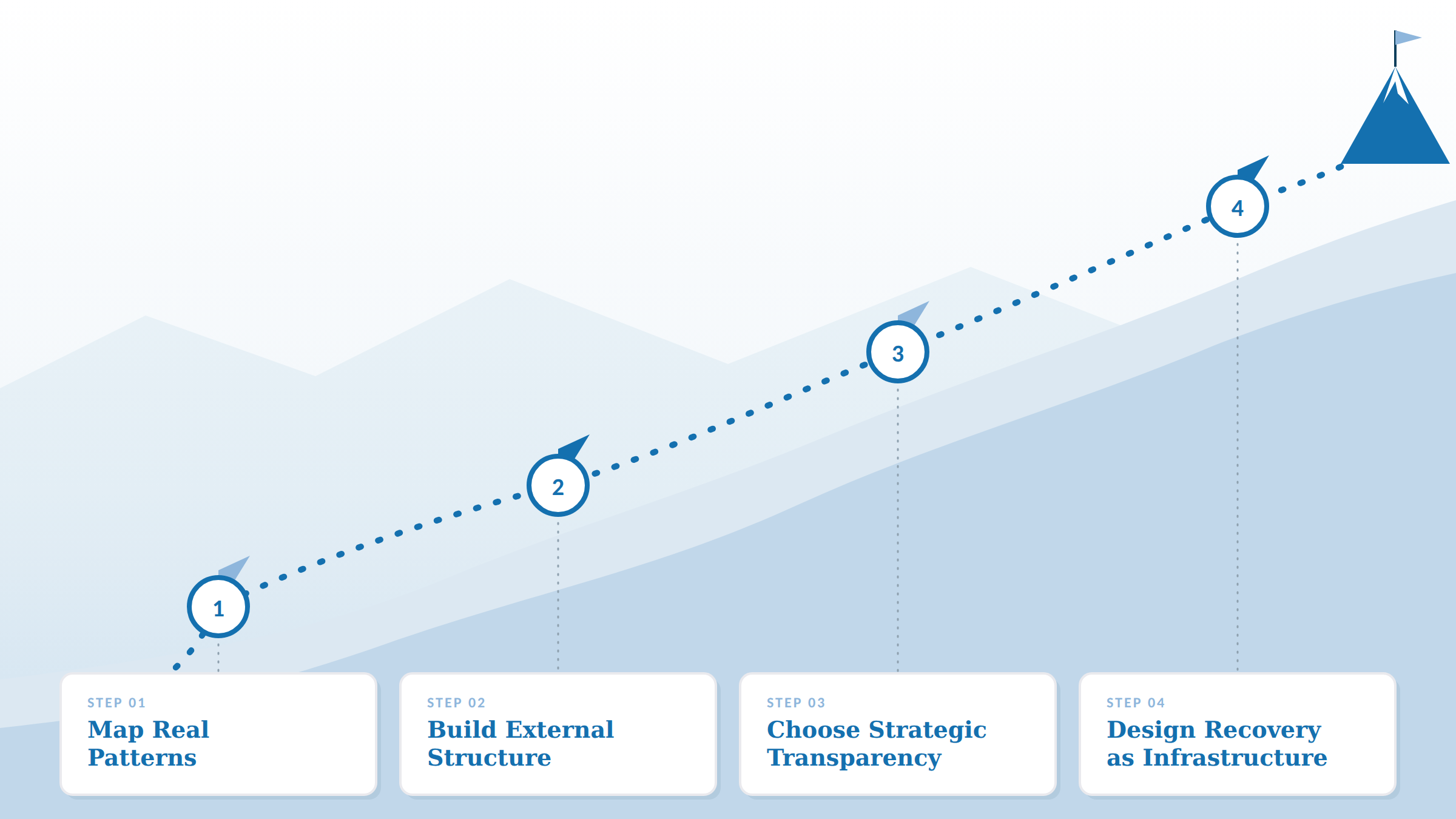
Here’s the core shift, and it’s the one that changes everything else: stop treating your neurodivergence as a defect to manage and start treating it as a design constraint to build around, the same way any good architect designs around the actual terrain instead of pretending the land is flat.
That shift shows up as four concrete moves.
1. Map Your Real Patterns, Not Your Ideal Ones
Most productivity advice starts from an idealized version of your day, the one where you’re disciplined, rested, and focused on command. Building with your brain starts somewhere more honest: what actually happens. When is your focus genuinely sharp? When does it reliably disappear? What kind of tasks drain you in twenty minutes versus the ones you could do for four hours without noticing? This isn’t self-judgment, it’s reconnaissance. You can’t route a path through terrain you haven’t actually surveyed.
2. Build External Structure Instead of Relying on Willpower
Willpower is a finite, inconsistent resource for every brain, and an especially unreliable one for a neurodivergent brain under stress. The fix isn’t trying harder to summon more of it, it’s moving the load outside your head entirely. External calendars that force decisions in advance, systems that catch things before they’re forgotten instead of relying on memory, environments engineered so the easy default is also the right one. Structure isn’t a crutch. It’s infrastructure, and infrastructure is what lets a system run without depending on someone’s mood that day.
3. Choose Transparency With Your Team Strategically
You don’t owe anyone your full diagnostic history, and oversharing isn’t the goal. But strategic transparency i.e. telling your team how you actually work, not how you wish you worked tends to build more trust than masking ever does. Something as simple as “I process best out loud, so expect me to think through decisions in real time rather than presenting them fully formed” reframes a quirk as a known operating mode instead of an unpredictable variable people have to work around in silence.
4. Design Recovery as Infrastructure, Not an Emergency
If you only rest once you’ve hit a wall, rest will always feel like damage control. Founders who break the boom-bust cycle build recovery into the system on purpose, protected low-output periods, buffer time after high-intensity sprints, permission to downshift before the crash instead of after it. Recovery stops being something you owe your body an apology for and becomes a planned part of how the business actually runs.
Put together, these four moves are the difference between constantly fighting your own operating system and finally building on top of it.
What This Looks Like in Practice for a Tech Founder

The framework isn’t theoretical. It shows up in the actual mechanics of running a company.
Hiring looks like being upfront in interviews about how you communicate and make decisions, then deliberately hiring for complementary strengths, for example, a detail-oriented ops hire if you’re a big-picture hyperfocus type, a steady closer if you’re the one who generates ten ideas a week and needs help finishing three of them.
Board and investor communication looks like building your own pre-meeting structure, a written brief you draft the day before instead of trying to think on your feet in real time, a standing format for updates so you’re not reconstructing your thinking from scratch under pressure every quarter.
Product cycles look like designing sprints around your actual energy patterns instead of an arbitrary two-week grid, building in the deep-focus blocks where your hyperfocus can do its best work, and protecting the lower-capacity stretches instead of scheduling your most demanding decisions right into them.
None of this requires disclosing a diagnosis to your board or rebuilding your company culture around your brain. It requires knowing your own terrain well enough to build a system that works with it instead of quietly fighting it every single day.
Frequently Asked Questions
Is neurodivergent leadership just an excuse for bad habits? No. The goal isn’t to lower the bar or excuse poor performance, it’s to raise your actual, sustainable performance by designing systems that work with how you’re wired instead of ones that only work when you’re forcing yourself through sheer effort. Accountability still matters. It just gets built into structures you can actually maintain, instead of relying on willpower that predictably runs out.
Do I need a formal diagnosis to benefit from this approach? No. Plenty of leaders recognize these patterns in themselves long before, or entirely without, a clinical diagnosis. The framework is about working with your actual patterns of focus, energy, and communication and you don’t need a label to start paying attention to those and building around them.
How is this different from generic executive coaching? Most executive coaching assumes a fairly standard cognitive baseline and layers strategy on top of it. This starts one level deeper with how your brain processes focus, time, and stress and builds the leadership strategy on top of that real foundation instead of an assumed one. It’s also worth saying plainly: this is founder-to-founder coaching grounded in lived experience and real strategy work, not a clinical or therapeutic service.
Will this help if I’m already successful and just feel like I’m barely holding it together? This is often exactly the person it helps most. Plenty of neurodivergent founders are visibly succeeding while privately running on fumes, held up by systems that only work because they’re pushing through sheer exhaustion. This framework is built for closing that gap between how things look and how sustainable they actually feel.
What if my team doesn’t know I’m neurodivergent? That’s entirely your call, and this approach doesn’t require disclosure. Plenty of structural changes like how you run meetings, how you communicate decisions, and how you protect recovery time work whether or not anyone else knows why you’re making them.
You Don’t Need a Different Mountain. You Need a Guide Who Knows Your Terrain.
If any of this sounds like your last several years, here’s the thing worth sitting with: none of it means you’re doing leadership wrong. It means you’ve been trying to summit using someone else’s route, on terrain that was never going to match it. There’s nothing broken about needing a different path — you just need one that was actually built for the ground you’re standing on.
That’s the work I do with founders and leaders in this exact spot. Not a program that asks you to become a different kind of leader, but one that helps you get sharper, steadier, and more sustainable as the one you already are. If you’re ready to stop white-knuckling your way through a mold that was never built for your brain, book a Pathfinding Call and let’s figure out the route together.
