

Why “Time Blindness” Isn’t a Character Flaw: A Guide for ADHD Founders
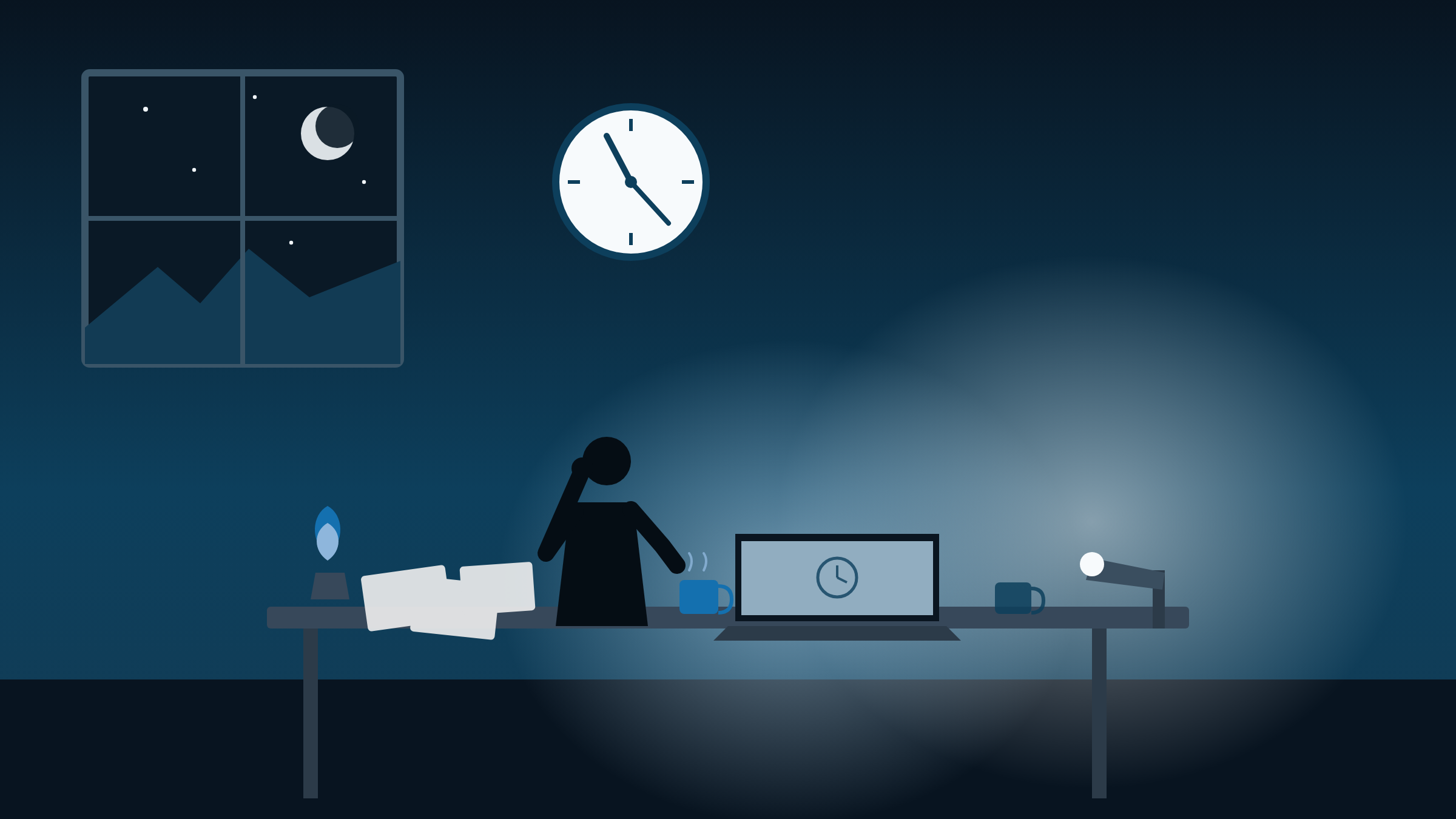
It’s 11:40pm the night before your board meeting. You told yourself you’d finish the deck by dinner. Instead, you’re three tabs deep in a competitor’s pricing page, the slides are half-built, and you have that familiar sinking feeling: I had all week for this. Where did the time go?
If this sounds like your Tuesday, you’re not lazy, and you’re not bad at your job. You’re likely dealing with time blindness; a real, well-documented feature of ADHD brains where your internal sense of time doesn’t reliably track with the clock on the wall. It’s not about caring less or trying harder. It’s a difference in how your brain perceives, estimates, and plans around time itself.
This is for founders and leaders juggling investor updates, sprint deadlines, hiring pipelines, and a hundred Slack threads, whose relationship with time has real financial and professional consequences. Here’s what time blindness is, how it uniquely disrupts building a company, why the standard advice doesn’t stick, and what genuinely helps.
What Time Blindness Actually Is (It’s Not a Willpower Problem)
Time blindness is a well-recognized part of ADHD, rooted in how the brain’s executive function system handles “time perception.” Most brains have a kind of internal stopwatch quietly running in the background, giving a rough, felt sense of how much time has passed or how long something will take. ADHD brains often don’t get that same signal or they get it inconsistently.
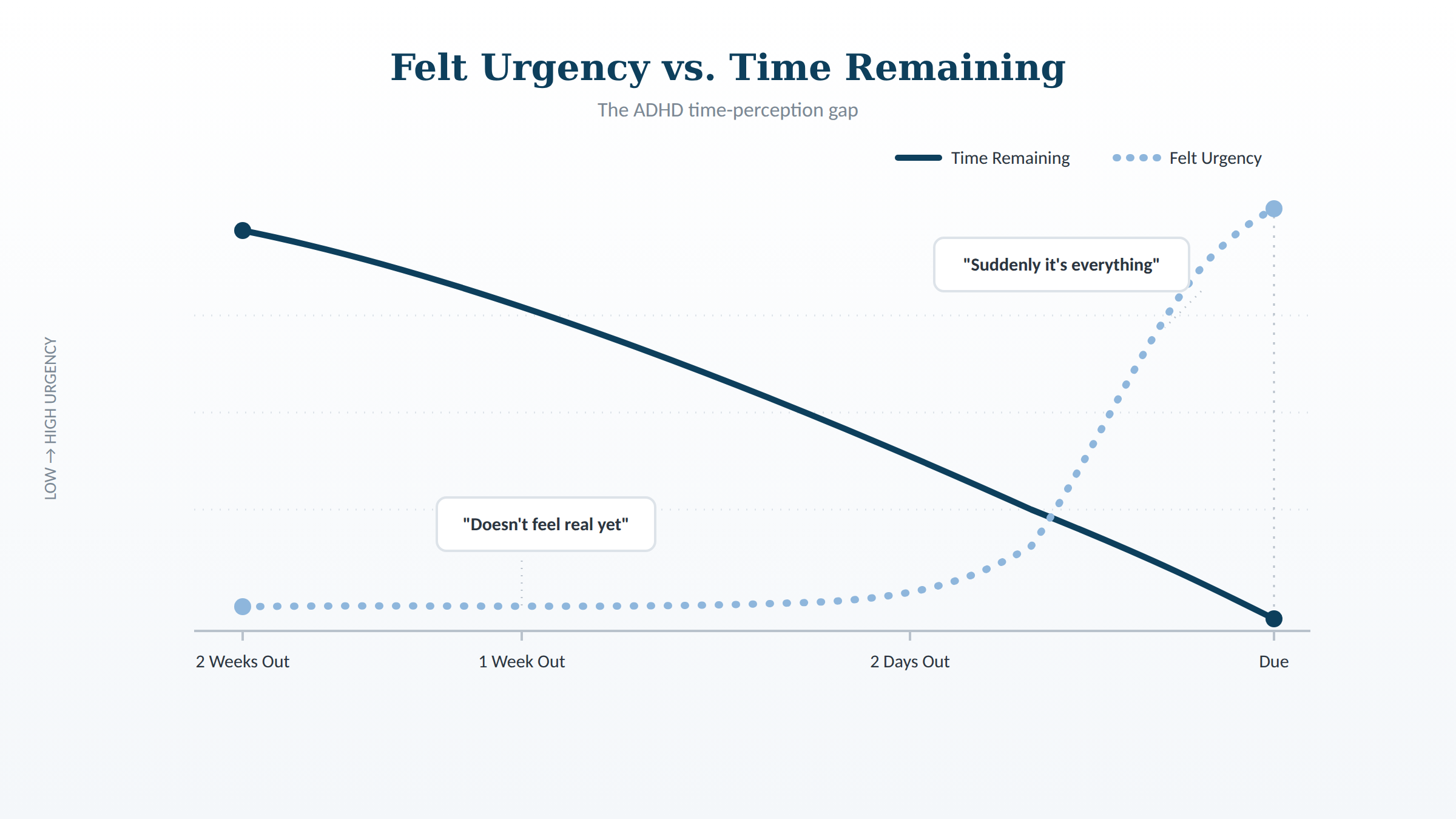
Practically, this shows up in two directions at once. First, you underestimate how long things take and you genuinely believe you can knock out a pitch deck in 45 minutes, even though it has never once taken less than three hours. Second, time doesn’t feel real until it’s urgent. A deadline two weeks out has no emotional weight. The same deadline two hours out suddenly has all the weight, and your brain finally engages while often producing your sharpest work, at the cost of your evening, your sleep, or your nervous system.
This is sometimes called a “now vs. not now” relationship with time, rather than a “past, present, future” one. It’s not a character flaw. It’s a wiring difference and once you understand it as that, you can stop trying to white-knuckle your way through it and start building around it.
How Time Blindness Shows Up When You’re Running a Company
Generic ADHD content tends to talk about being late to appointments or losing track of laundry. That’s real, but if you’re running a company, time blindness shows up in ways that carry real stakes: reputational, financial, and sometimes legal.
Investor Updates and Board Decks
You know the update is due. You’ve known for two weeks. And yet it doesn’t become real until the night before, at which point you’re pulling numbers together at 6am, writing a narrative you haven’t had time to think through, and sending something that undersells a genuinely good quarter because you ran out of runway to make it sharp.
Sprint Deadlines and Launch Nights
Boom-bust is the pattern here: weeks of scattered, low-output days followed by 48 hours of caffeine-fueled hyperfocus to hit a launch date. It works… until it doesn’t. Until the all-nighter introduces a bug nobody catches, or the team starts quietly resenting the pattern, or you’re too fried the following week to capitalize on the momentum you just created.
The “Quick Call” That Eats Your Afternoon
You block 30 minutes for a call. It’s still going at minute 75. Not because the conversation wasn’t worth having, but because once you’re inside a conversation, your sense of elapsed time evaporates. Multiply that by four calls a day and your calendar is now lying to you by early afternoon.
Hiring Timelines That Quietly Stall
You meant to get back to that great candidate within a week. It’s been three because “follow up with candidate” lived in your head as a someday task with no felt urgency, and “someday” came and went while you were heads-down on something that did feel urgent. Now you’re writing an apologetic email hoping they haven’t accepted another offer.
None of this is about discipline. It’s a mismatch between how your brain tracks time and the rigid, clock-based demands of running a company that other people like investors, employees, candidates all depend on.
Why “Just Use a Calendar App” Doesn’t Work
If a calendar reminder actually solved time blindness, this wouldn’t be a lifelong pattern for so many founders and most have already tried three calendar apps, two time-blocking methods, and a productivity system that worked great for eleven days.
The reason those tools stall out: they’re built on the assumption that knowing the time will change your feeling about the time. But time blindness isn’t an information problem. You already know the board meeting is Thursday. What’s missing is a felt, visceral sense of time passing and, for people that experience this, that has to be engineered externally, because your internal system won’t reliably supply it.
What tends to actually work is less about tools and more about a shift in strategy:
• Externalize time, don’t just track it. Visual and physical time cues such as a timer you can see counting down, a second monitor with a running clock, or an actual alarm do more than a calendar notification, because they create ambient urgency instead of a one-time ping you can dismiss and forget.
• Build in padding as policy, not guilt. If everything takes 1.5–2x your estimate, stop treating that as a personal failure and start treating it as a known multiplier to plan around, especially for deadlines you give investors or your board.
• Anchor big deadlines to smaller, externally-enforced checkpoints. A deadline three weeks out won’t feel real. A check-in with a coach, an accountability partner, or a co-founder every few days will. The goal is to borrow urgency from outside your own head.
• Design your week around your actual energy patterns, not the idealized version of yourself who does deep work every morning at 8am. If your best focus shows up at 10pm, protect that window instead of fighting it.
This is systems-level work, not a productivity hack. It’s the difference between trying harder inside a system that was never built for how your brain works, and building a system that already accounts for it.
Time Blindness and Your Team: Delegation, Transparency, Trust

Here’s the part that gets left out of most advice on this topic: time blindness doesn’t just cost you personally. Left unmanaged, it quietly erodes trust with the people you lead.
If deadlines you set consistently slip, or you’re chronically late to meetings you called, your team notices and starts padding anything they hear from you, which slows the whole company down. If you’re the bottleneck on every decision because everything feels equally urgent, your team can’t move without you, which isn’t sustainable past two people.
The fix isn’t to mask it better. It’s to name it, clearly and without over-explaining, then build structure around it. Something as simple as: “I run on tight deadlines better than distant ones i.e. if something’s time-sensitive, flag it directly and give me a real due date, not a soft one.” That’s not a confession of weakness. It’s operational clarity, and most teams respect that far more than a leader who quietly flakes and ever explains why.
Delegation follows the same logic. The instinct when you don’t trust your own sense of time is to hold onto everything so you can personally feel the urgency. The more sustainable move is to delegate the tracking, not just the task, this give someone real ownership of deadlines and the authority to chase you down. You stop being the single point of failure for time, and your team gets a clearer, more consistent version of you in return.
FAQ
Is time blindness a real medical thing, or is it an excuse? It’s a recognized, well-documented feature of how ADHD affects executive function and time perception. Naming it accurately is what makes it possible to actually address, instead of just feeling bad about it.
Can ADHD time blindness get better with age or experience? It can get more manageable, but usually because of better systems and self-awareness, not because the underlying wiring changes on its own. Founders who’ve run companies for a decade still experience time blindness and they’ve just gotten better at building structure around it, often after a few expensive lessons.
How do I explain this to my team without it sounding like an excuse? Keep it short, specific, and forward-looking: name the pattern, then say what you need from them. “I don’t have a great internal sense of urgency for things that feel far away so if it’s time-sensitive, tell me directly and give me a real deadline” reads as self-aware and useful, not as an excuse. The difference is that it comes with an ask, not just an apology.
Why do I underestimate how long everything takes, even things I’ve done a hundred times? This is sometimes called the “planning fallacy,” and it’s amplified in ADHD brains because your internal time-tracking doesn’t reliably learn from past experience the way you’d expect. The workaround is building in a standing multiplier (often 1.5–2x your gut estimate) and treating that as data that you work with.
Does this ever fully go away? For most people, no, but “fully going away” isn’t really the goal. The goal is building a life and a company that don’t depend on you having a reliable internal clock, so the trait stops being a liability and just becomes one more thing you’ve designed around.
You Don’t Need a Better Calendar. You Need a Better System and Someone Who Gets It.
Time blindness isn’t a flaw you need to fix before you’re allowed to lead well. It’s a real difference in how your brain works, and once you stop fighting it and start building around it, it stops running your calendar and your company for you.
If you’re a neurodivergent founder tired of white-knuckling your way through deadlines that never feel real until they’re on fire, you don’t have to figure this out alone. That’s exactly the kind of work I do in coaching by building systems, structure, and self-trust that fit how your brain operates and not asking you to keep forcing yourself into a system that was never built for you.
If that sounds like what you need right now, book a Pathfinding Call and let’s map out what working with your brain could actually look like.
