

Diagnosed as an Adult, Already Running a Company: What Actually Comes Next

You’re sitting in your car in a parking lot, or staring at a video call screen that’s just gone dark, holding a diagnosis you did not see coming. ADHD. Maybe autism too. You’re not nineteen and figuring out your major. You’re forty-one and you have a company, a team that reports to you, a board that expects updates, revenue that depends on decisions you make every day. And somehow, in the middle of running all of that, you just got confirmation that your brain has been working differently the entire time.
The feelings that show up next don’t arrive one at a time. Relief, because it finally explains so much like the boom-bust cycles, the meetings you white-knuckled through, the way you always felt one beat behind your own competence. And grief, sharp and sudden, for every year you spent thinking the problem was that you weren’t disciplined enough, weren’t trying hard enough, weren’t enough, period. Both of those things are true at once, and that’s disorienting in a way that’s hard to explain to someone who hasn’t lived it.
What you won’t find much of is guidance written for exactly where you’re standing. Most “now what” content assumes you’re job-searching, or in school, or newly out of college. It doesn’t account for the fact that you already have people whose paychecks depend on you, investors who want a steady hand, and a business you built, however perfectly or imperfectly, with the very brain you’re now seeing clearly for the first time. This is that guide. Not a clinical overview, not a listicle of coping hacks, but a real look at the questions you’re actually facing right now as someone who leads.
Why This Is Happening to So Many Leaders Right Now
If it feels like you’re suddenly seeing this diagnosis everywhere, you’re not imagining it. A wave of adults, disproportionately women and high-achievers, are being diagnosed with ADHD or autism well into their careers, often decades after the signs first showed up. The reasons are mostly mundane and unglamorous: better public understanding of how these conditions actually present (especially in people who learned to mask them well), a child’s diagnosis that suddenly holds up a mirror, or years of quietly white-knuckling through burnout until something finally breaks and a doctor asks the right questions.
None of that means anything is more “wrong” with you than there was last month. It means the explanation caught up to the experience. You built a career, maybe a company, compensating for something nobody had named for you yet. That’s not a small thing to metabolize, and it deserves more than a five-minute Google search and a productivity app.
The Emotional Whiplash of Being “Successful” and Newly Diagnosed
Here’s the part almost nobody prepares you for: success complicates this diagnosis instead of softening it.
When Imposter Syndrome Flips Into Something Else
Maybe you’ve spent years quietly convinced you were faking competence, that any day now, someone would notice you were improvising the whole time. A late diagnosis doesn’t erase that feeling. It flips it into a stranger question: how did I build any of this without knowing what I was working with? That question can sound like an insult to yourself, but it’s worth sitting with as something closer to awe. You didn’t luck your way into a company. You built systems, messy, self-taught, expensive ones, to work around a brain nobody had explained to you. That’s not evidence you’re a fraud. It’s evidence you’re resourceful under conditions most people never have to navigate.
Reframing the Past Without Rewriting It
You’ll be tempted to comb back through every past failure and relabel it, that partnership that fell apart, the year you missed every deadline, the cofounder who eventually walked… Some of that reframing is useful. Some of it isn’t fair to the person you were, who was doing real work with information you didn’t have yet. The goal isn’t to excuse every past decision or to blame all of it on an unnamed condition. It’s to finally understand the terrain you were working on, so you can navigate it more deliberately going forward, not to rewrite the whole map.
Do You Tell Your Team, Co-Founders, Board, or Investors?

There is no universal right answer here, and anyone who tells you there is hasn’t actually sat in your chair. What there is, is a framework you can use to make the decision that’s right for your specific situation.
Ask yourself these four questions before you decide anything:
1. Who is actually affected by how you work, not just curious about your diagnosis? A co-founder who’s noticed you need different meeting formats to think clearly is affected. A board member who’s never once mentioned your working style probably doesn’t need a diagnosis-shaped explanation for anything.
2. What would disclosure actually change, practically? If naming this to your team would let you finally ask for the accommodations you’ve been quietly engineering around for years such as written follow-ups instead of verbal asks and agendas sent in advance are real, tangible benefit. If it wouldn’t change a single workflow, you don’t owe anyone the information just because you have it.
3. What’s your read on the room? Some investors and boards are genuinely forward-thinking about neurodivergence in leadership. Others are not, and pretending otherwise because you wish it were true can put your company at risk. Be honest with yourself about which kind of room you’re in.
4. Can you separate “telling people” from “changing how you operate”? These don’t have to happen together. You can shift how you run meetings, delegate, or structure your week without ever using a diagnostic label out loud. Disclosure and adaptation are two different decisions — you’re allowed to make one without the other.
There’s no requirement to disclose anything to anyone unless you choose to, and no moral high ground in oversharing just because the truth feels heavy to carry alone. This is your information. You get to decide who earns access to it, on your timeline, for your reasons.
Where to Actually Start
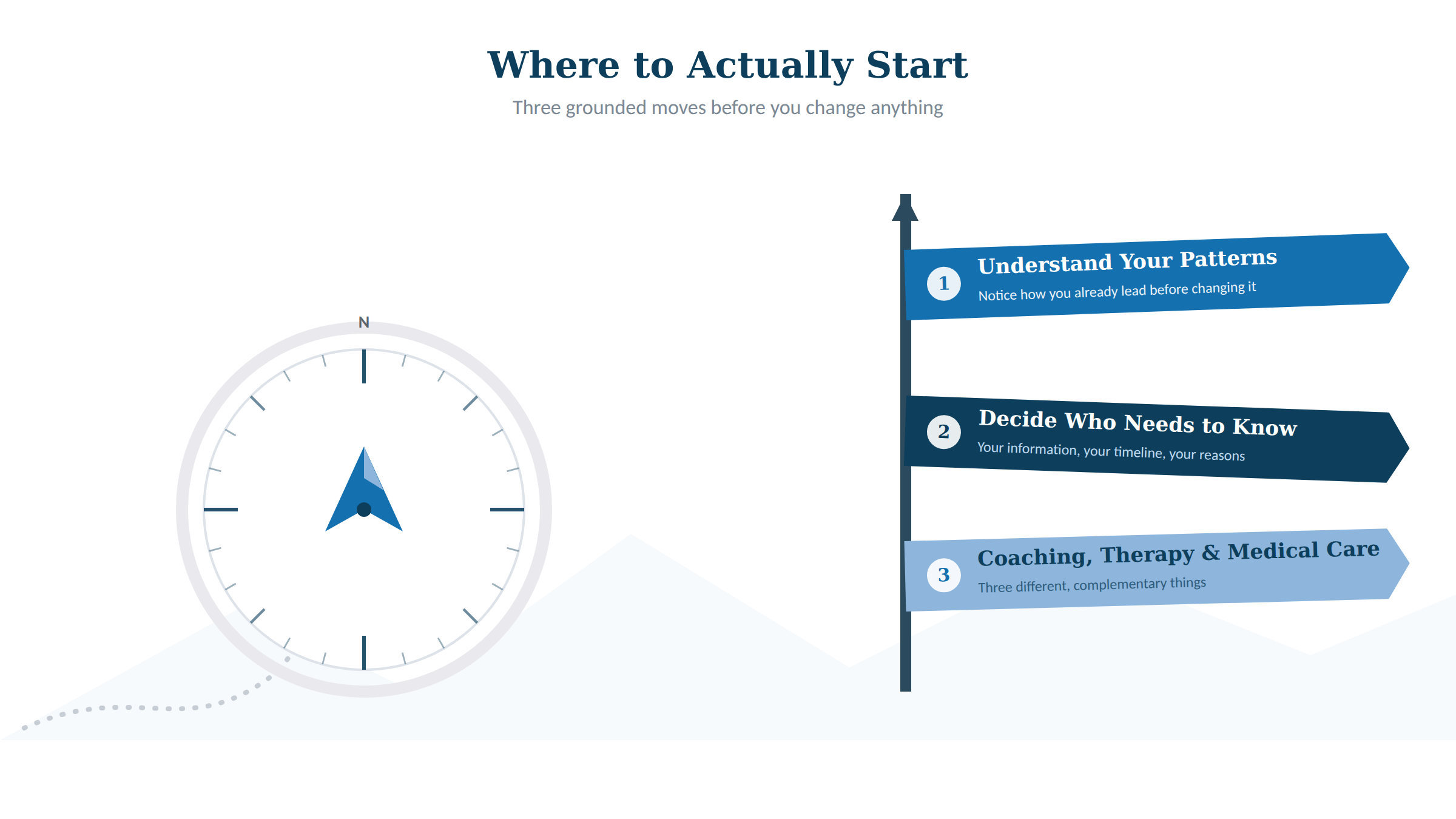
Not a self-care list. Not “get more sleep.” Here’s what actually matters in the first few months.
Understand Your Patterns Before You Change Anything
Resist the urge to overhaul your entire leadership style in week one. Before you change how you run your company, spend real time noticing how you already run it, when you do your clearest thinking, what kind of meetings drain you versus energize you, which tasks you’ve been avoiding and why. You’ve been managing this brain successfully for years without a name for it. Now you get to do it on purpose, with information, instead of by accident.
Decide Who Needs to Know
Use the framework above, but don’t rush it. You don’t need to make every disclosure decision this month. Some conversations, with a spouse or a close cofounder, might happen soon because you need the support. Others, like with your board, can wait until you actually know what you want to ask for.
Treat Coaching, Therapy, and Medical Care as Different, Complementary Things
These three are not interchangeable, and you likely need more than one.
• A doctor or psychiatrist is the right person to talk through diagnosis, medication, and any clinical treatment questions. This conversation belongs with a medical professional who knows your full history, not a coach, a founder friend, or a search engine.
• Therapy can help you process the grief, identity questions, and years of self-blame that a diagnosis this late in life tends to surface. That processing work matters and deserves its own dedicated space.
• Coaching is where you translate all of this into how you lead, how you structure your week, communicate with your team, and make decisions that work with your brain instead of constantly overriding it. It’s the strategic and practical layer, not the clinical one.
None of these replace the others. Most people navigating a late diagnosis while running a company end up needing some combination of all three.
Frequently Asked Questions
Do I need to tell my investors or board? No, there’s no legal or ethical obligation to disclose a diagnosis to your board or investors. The real question is whether disclosure would change anything practical about how you work together. If it would, consider it. If it’s purely about wanting to be known and understood, that’s valid too, but it’s a personal choice, not a requirement.
Is it too late to change how I lead? No. You built a company operating on instincts you’re only now able to name. Understanding those instincts doesn’t threaten what you’ve built. It gives you a clearer set of tools to keep building it, with less friction and less self-imposed struggle than before.
Should I get coaching, therapy, or medication or all three? It depends on what you’re navigating. Medication and clinical treatment decisions belong with a doctor. Processing the emotional weight of a late diagnosis often benefits from therapy. Translating your diagnosis into how you actually run your business and lead your team is where coaching fits. Many leaders find they need pieces of all three, on different timelines.
How do I stop relitigating every past decision through this new lens? Give yourself a real timeframe to reflect, and then redirect that energy forward. Reframing the past is useful in small doses and it can help you understand patterns. It stops being useful when it becomes a loop of self-blame dressed up as self-awareness.
What if I’m scared this changes how my team sees me? That fear is common and worth taking seriously rather than dismissing. It’s also a good reason to move deliberately rather than reactively and decide what you want people to know, and why, before you say anything out loud.
You Don’t Have to Figure This Out Alone
A late diagnosis while you’re already leading a company is its own particular kind of mountain because most of the maps out there weren’t drawn for someone standing where you are. You don’t need to overhaul everything overnight, and you don’t need to have this figured out by yourself.
If you’re looking for a thinking partner who’s not going to hand you a generic playbook, someone who can sit with you in the practical, founder-specific questions of what comes next, a Pathfinding Call is exactly that: a real conversation about where you are and what the next stretch of the climb could look like for you.
