

Boom-Bust Cycles: Why Neurodivergent Founders Swing Between Hyperfocus and Burnout and How to Break the Pattern

Three weeks before launch, you were unstoppable. Ninety-hour weeks felt easy. You rewrote the onboarding flow at 2 a.m. because a better idea wouldn’t let you sleep, answered every beta user’s email within minutes, and told your co-founder this was the best you’d felt about the company in a year. Launch day came, and went well. Then something happened that’s hard to explain to anyone who hasn’t lived it: you disappeared.
Not physically — you were still there. But Slack messages sat unread for two days. A simple vendor decision felt like it required more energy than you had. Your co-founder started every message with “no rush, whenever you get a chance,” their polite way of saying they’d noticed. You weren’t lazy or unmotivated. You were running on empty after weeks of running on nothing but adrenaline and dopamine, and nobody had told you the bill would come due like this.
If this sounds familiar, you’re not broken, and you’re not the only founder living this way. This is a real, well-documented pattern in a lot of ADHD and autistic brains, and it has a mechanism and, more usefully, a way to build around it instead of white-knuckling through it every time. That’s what this post is for.
What’s Actually Happening in Your Brain (Briefly, No Jargon Overload)
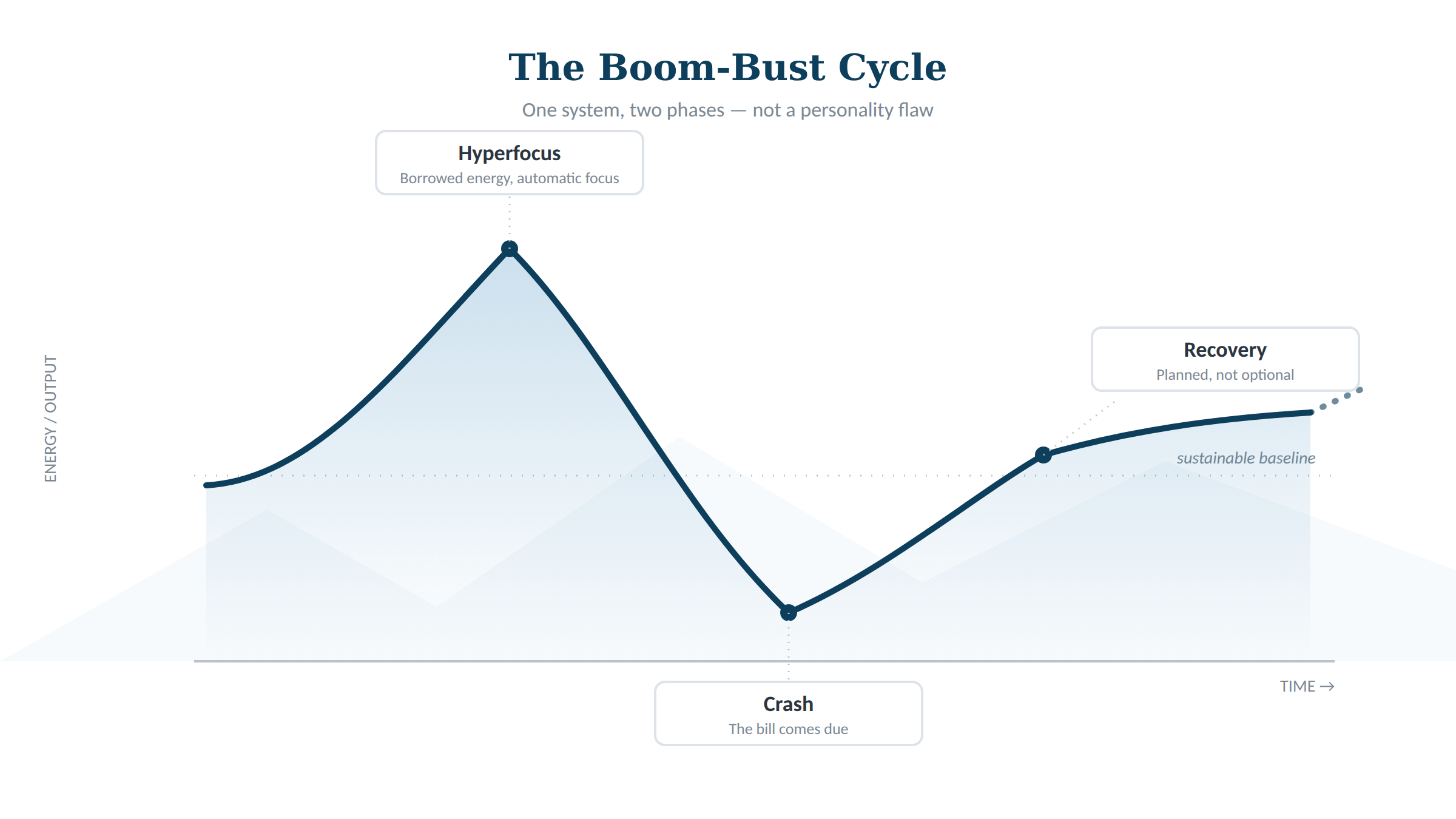
Here’s the short version, no neuroscience lecture, just enough to stop blaming your character for it.
ADHD brains are chronically under-stimulated at the level of dopamine, the neurochemical tied to motivation and follow-through. Ordinary tasks like email, admin, or a project with no visible finish line don’t generate enough of it to feel doable. But something urgent, novel, or high-stakes like a launch, a pitch, or a genuinely interesting problem floods the system, and focus stops being a struggle and becomes automatic. That’s hyperfocus. It isn’t discipline or finally “getting it together”, it’s your brain getting a chemical hit it’s been starved of, and riding it as far as it goes.
The catch is that hyperfocus runs on borrowed energy. It overrides normal signals like hunger, fatigue, and stress, because the task has hijacked your attention completely. When it ends, there’s no gradual landing, there’s a crash. The same brain chemistry that made you unstoppable now makes basic tasks feel like wading through wet concrete. This isn’t a strength followed by a moral failing. It’s one system, two phases and seeing it that way is the first step to designing around it instead of being ambushed by it.
Why This Cycle Is Especially Dangerous When You’re the Founder
Plenty of people experience some version of hyperfocus and crash. But if you’re an employee, there’s usually a manager or team structure that absorbs the dip. When you’re the founder, there’s often no one catching what you drop.
No safety net underneath you. An employee having an off week gets covered by teammates. A founder having an off two weeks means decisions stall, deals go cold, and the things only you know how to do simply don’t get done.
Your team reads your energy as the weather. Whether you say it out loud or not, your team calibrates to you. When you’re in hyperfocus mode, everything feels urgent and everyone scrambles. When you crash, the whole company’s temperature drops with you but not because anyone’s told to slow down, but because your checked-out energy becomes the ambient signal for how much anything matters right now.
Investors and boards notice inconsistency before they notice cause. Nobody outside your head sees “brilliant three-week sprint followed by necessary recovery.” They see a founder who was everywhere and is now unreachable, and they draw their own conclusions which is usually at the worst possible time, like right before a board meeting.
The guilt compounds the crash. The bust phase already comes with reduced executive function. Layer shame on top with self messages like, “I should be able to push through, what’s wrong with me” and recovery takes even longer, because you’re spending scarce energy managing shame instead of actually resting.
None of this means you’re unfit to run a company. It means the cycle needs infrastructure that most founder advice never accounts for, because it’s written for a brain that doesn’t work this way.
“Pushing Through” vs. Building Systems Around the Pattern
Almost every founder’s first response to the crash is to push through it: more coffee, more willpower, a stern talk about discipline. It works for a day, maybe two. Then the crash deepens, because you’ve spent already-depleted reserves forcing output your brain wasn’t ready to give.
Pushing through treats the cycle as a personal failure to override. It assumes the goal is to flatten your energy into a steady line and when that doesn’t happen, which won’t because this isn’t how your brain is wired, it reads as more evidence something’s wrong with you.
The alternative isn’t “manage your ADHD better.” It’s building your business, your calendar, your team structure, your decision-making process so the cycle has somewhere to go that doesn’t take the company down with it. Your energy pattern is a real, predictable operating condition of your business, the same way cash flow seasonality is. You plan around it instead of hoping it behaves differently next quarter.
That shift, from personal wellness problem to operational design problem, is the difference between founders who white-knuckle the same cycle for years and founders who build something that holds.
A Practical Framework: Designing a Business That Works With Your Cycle

You can’t eliminate the boom-bust pattern, and trying to is a losing game. What you can do is build guardrails so the boom doesn’t create damage the bust can’t recover from.
1. Buffer time as a default, not an emergency measure
Build recovery time into your actual calendar before you need it, not after you’ve already crashed. If a launch or big push is coming, block the two weeks after it as low-demand time before you commit to anything else. Treat that buffer like a runway calculation: non-negotiable, planned in advance, not a “nice to have” you cut when things get busy.
2. Delegation triggers, decided in advance
Don’t wait until you’re mid-crash to figure out what needs to happen without you. In a clear-headed moment, decide: if I go quiet for more than X days, here’s who has authority to make Y and Z decisions without waiting for me. Write it down. This is the same instinct as a succession plan or disaster recovery process as it removes the highest-stakes decisions from your lowest-capacity moments.
3. Honest team communication
You don’t owe your team a diagnosis. What builds trust is naming the pattern in operational language: “I tend to have high-intensity stretches followed by lower-output stretches. Here’s how we’ll handle the second kind so nothing depends entirely on my day-to-day bandwidth.” Said once and reinforced through the systems around it, that does more for team confidence than either hiding the pattern or apologizing for it every time it shows up.
4. Recovery as a scheduled input
The bust phase isn’t optional, it’s a cost already incurred by the hyperfocus phase, whether you plan for it or not. The only choice is whether it happens on your terms, scheduled and supported, or on its own terms, at the worst possible moment. Put recovery on the calendar the way you’d put a product deadline on the calendar. It’s the maintenance cost of the exact intensity that makes you good at what you do not indulgent.
FAQ
Is it possible to have consistent, steady energy with ADHD, or should I stop trying? Perfectly flat, steady energy probably isn’t a realistic goal, and chasing it can create more shame than progress. A more useful goal is a predictable cycle instead of an unpredictable one and knowing roughly when a push is coming, planning the recovery that follows it, and building your business so neither phase catches your team or your numbers off guard.
How do I tell my team about this pattern without losing their confidence? Frame it in terms of how the company operates, not as a personal disclosure. Teams generally don’t lose confidence in founders who are direct about how they work and back it up with real systems like delegation triggers and clear decision authority during low-bandwidth stretches. They lose confidence in founders who are inconsistent and unpredictable and silent about it.
Is this the same as bipolar disorder? No. Bipolar disorder involves distinct mood episodes tied to changes in mood, sleep, and behavior over days to weeks, and it’s a different clinical picture with its own treatment path. The ADHD hyperfocus-to-crash cycle is driven by dopamine regulation and attention, not mood episodes, and it typically tracks with specific triggers like a big push or deadline rather than occurring independently of them. If you’re ever unsure which pattern you’re experiencing, that’s a conversation for a medical or mental health professional where as this article is about building your business around a known ADHD pattern, not diagnosing anything. I am not a doctor.
Why do I burn out specifically after hyperfocus, even when the outcome was good? Because hyperfocus runs on borrowed resources and it overrides normal hunger, fatigue, and stress signals so completely that the depletion doesn’t show up until the task is done. A successful launch still costs the same recovery debt as a stressful one. The outcome doesn’t change the bill; it just makes the bill feel more confusing, because you “should” feel good and instead you feel wiped out.
You Don’t Have to Keep White-Knuckling This
If you recognize yourself in this pattern, you’re looking at an operating condition of how your brain generates its best work, one that most business advice was never written to account for. The founders who build sustainable companies with this wiring aren’t the ones who found a way to stop the cycle. They’re the ones who stopped treating it as a problem to fix and started treating it as terrain to navigate, with real systems underneath them.
If you’re ready to stop white-knuckling your own energy and start building a business and a team that holds you up during both phases of the climb, I’d love to talk. Book a Pathfinding Call and let’s figure out what that looks like for you.
